Case Study — Finger Lakes Daily News
How a local news site rebuilt its entire technical SEO foundation with AI-powered engineering—then a major storm proved the system could scale.
The Challenge
When FLX Local Media acquired Finger Lakes Daily News in January 2026, the site had loyal readership but virtually no technical SEO infrastructure. No structured data. No performance optimization. No monitoring. No strategy for which content should—or shouldn't—be indexed.
The site was running on WordPress with default settings, serving a mix of original local reporting and syndicated national content through unoptimized templates. Lighthouse scores hovered around 54 on mobile and 69 on desktop. There was no JSON-LD structured data, no canonical URL strategy, and no mechanism to prevent thin or duplicate content from diluting the site's authority in search.
The goal: build a technical SEO foundation that lets the journalism shine in search—without months of manual optimization cycles. We needed a system that could audit, implement, and monitor at the pace of a 24/7 newsroom.
The Approach
We used Claude, Anthropic's AI assistant, as a core engineering tool across the entire technical SEO stack—from structured data implementation to edge caching configuration to automated health monitoring.
Structured Data
We designed a comprehensive structured data architecture from scratch—which schema types to implement, what signals to prioritize, and how to structure them for maximum search visibility. The result: a dynamic layer covering every content type on the site, generated from live WordPress data.
| Content Type | Schema | Key Signals |
|---|---|---|
| News Articles | NewsArticle | headline, author, dates, contentLocation with geo, isAccessibleForFree |
| Homepage | ItemList | Latest 9 articles for Top Stories carousel eligibility |
| Events | Event | Date range, venue Place with geo, Offer pricing, attendance mode |
| Obituaries | NewsArticle | Custom table data — funeral home as author, residence, dates |
| Radio Stations | RadioStation | Call sign, broadcast timezone, area served, app links |
| Local Businesses | LocalBusiness | Address, phone, email, sameAs links |
| Town Hubs | CollectionPage + City | Geo coordinates, population, parent county, article list |
| Weather | FAQPage | 5 Q&A pairs on conditions, radar, update frequency |
| Storm Alerts | LiveBlogPosting | Coverage start/end time, continuous updates format |
| All Pages | BreadcrumbList | Full hierarchy: Home → Category → Article |
| Site-Wide | NewsMediaOrganization | Identity, SearchAction for sitelinks search box |
Page Speed
A focused optimization sprint addressed every Core Web Vital across all page templates. Systematic, not incremental—root causes, not symptoms.
loading="eager" with fetchpriority="high". Preload hints include imagesrcset to prevent double-downloads.Indexing Strategy
Not everything should be in Google's index. We made data-driven decisions about what to show and what to hide.
Entertainment and national news sections were syndicated RSS feeds—identical content on hundreds of sites. They generated 683,000 impressions/month at 0.3% CTR from position 28. Actively hurting the site: diluting topical authority, wasting crawl budget, dragging down domain quality signals.
Solution: Noindex all syndicated sections. Results were immediate.
✓ Indexed
✗ Noindexed
☠ 410 Gone
Infrastructure
Technical SEO is more than markup and meta tags. It's the infrastructure that determines whether your site can serve the right content, fast, under load, with full observability.
The Proof Point
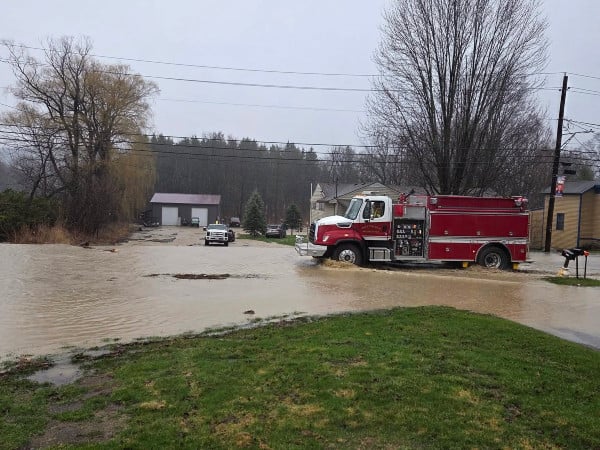
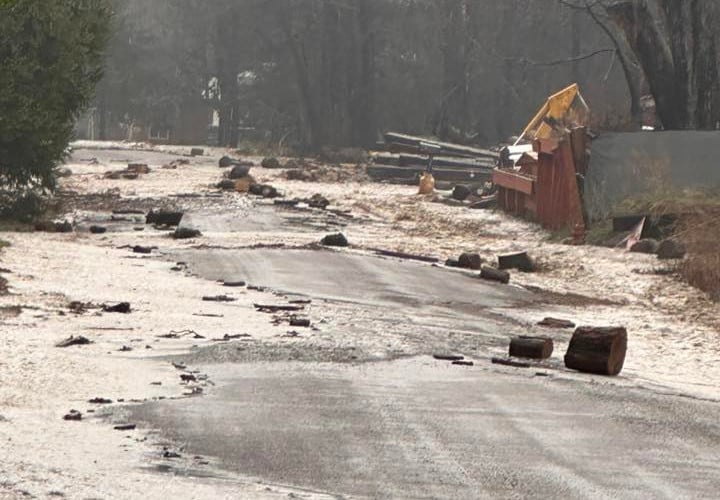
On March 30–31, 2026, a severe storm brought heavy rain, hail, and flooding to the Finger Lakes. The Weather Worker auto-published coverage. Social sharing drove a massive surge. In 48 hours, we served more requests than the previous month combined.
The Weather Worker detected NWS alerts and auto-published storm coverage with embedded radar maps—within 60 seconds of alert issuance. Google picked them up via the News Sitemap. The query "flood watch" generated 19,000+ impressions that week alone.
Edge caching absorbed the load. On March 31, Cloudflare served 58.5% from cache. By April 1, cache hit rate climbed to 87.5% as hot pages warmed. Average origin response time dropped from 300ms to 35ms.
For a local news site, weather events are the moments that matter most. When roads flood and power goes out, people need local information fast. This storm was the first real test of the entire technical stack built over the previous three months.
Zero downtime. Zero performance degradation. Automated publishing. Full observability. The system didn't just survive—it was designed for exactly this moment.
Results
Technical SEO doesn't produce overnight hockey sticks. It produces a steadily improving baseline—better indexing, better CTR, better position—that compounds over time and makes every piece of content work harder.
Share of voice measures what percentage of Google search results for a topic feature FLDN content. In a competitive local news market, SOV is the clearest indicator of topical authority—and it moved fast after the structured data and indexing changes took effect.
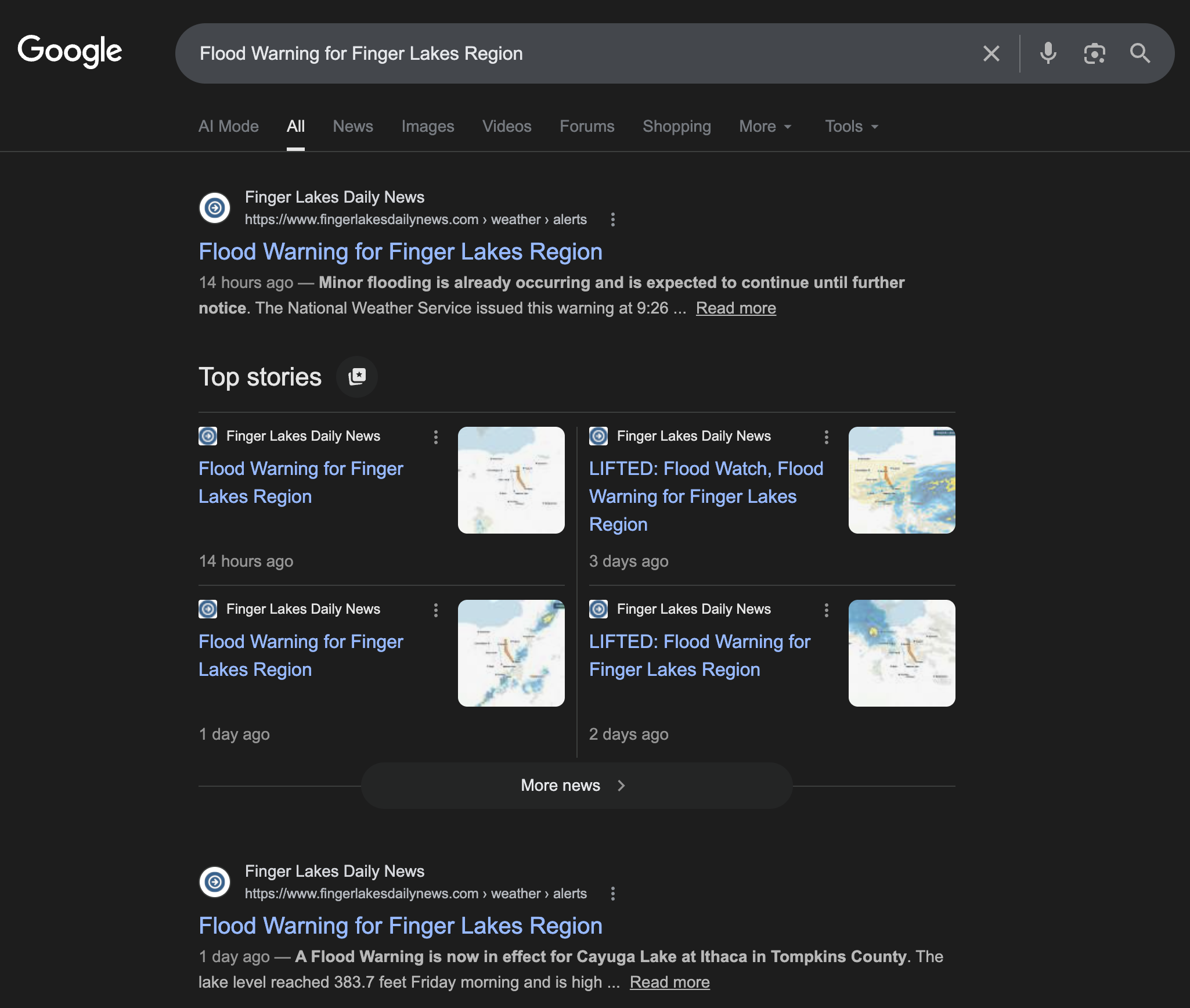
Three days after the storm, FLDN owned the entire first page of Google for “Flood Warning for Finger Lakes Region”—position 1, all four Top Stories slots, and position 2. Every visible result was FLDN content. This is what structured data + fast automated publishing + topical authority looks like in practice.
One of the less obvious benefits of comprehensive structured data: it makes your content legible to AI systems, not just traditional search crawlers. Since the structured data rollout, referral traffic from ChatGPT has grown from ~3 sessions/week to over 60—a 20x increase. AI engines like ChatGPT, Perplexity, and Copilot are citing FLDN articles directly in their responses.
This is the emerging discipline of Generative Engine Optimization (GEO)—ensuring your content surfaces in AI-generated answers, not just traditional SERPs. The structured data architecture is already paying dividends in this new channel, and we expect it to accelerate as AI search adoption grows.
Observability
Every metric in this case study is tracked in real-time through a custom analytics dashboard backed by BigQuery. Not a monthly PDF—a live operational tool.